When campaign performance stalls, advertisers often look first at the media plan: increase the budget, expand targeting, or invest in premium inventory. But what if the biggest opportunity lies in the creative itself?
For a LATAM campaign promoting the film Mickey 17, mediasmart compared standard display creatives with interactive rich media. Both formats ran side by side under the same campaign conditions, using the same inventory, audience, targeting, and CPM, making the creative the only meaningful variable. The results show how well-designed interactivity can significantly increase engagement without increasing media costs
Campaign Setup:
To ensure a fair comparison, both creatives ran under identical campaign conditions.
- Targeting: Mobile web and in-app inventory reaching audiences interested in Adventure, Action, Comedy, and Sci-Fi, focusing on men aged 25+ and women aged 17–34.
- Inventory: Standard display inventory only (no video or outstream).
- CPM: Both formats ran at the same CPM, with no premium for interactive media.
- Campaign: Both creatives ran within the same mediasmart campaign.
Interactive formats:
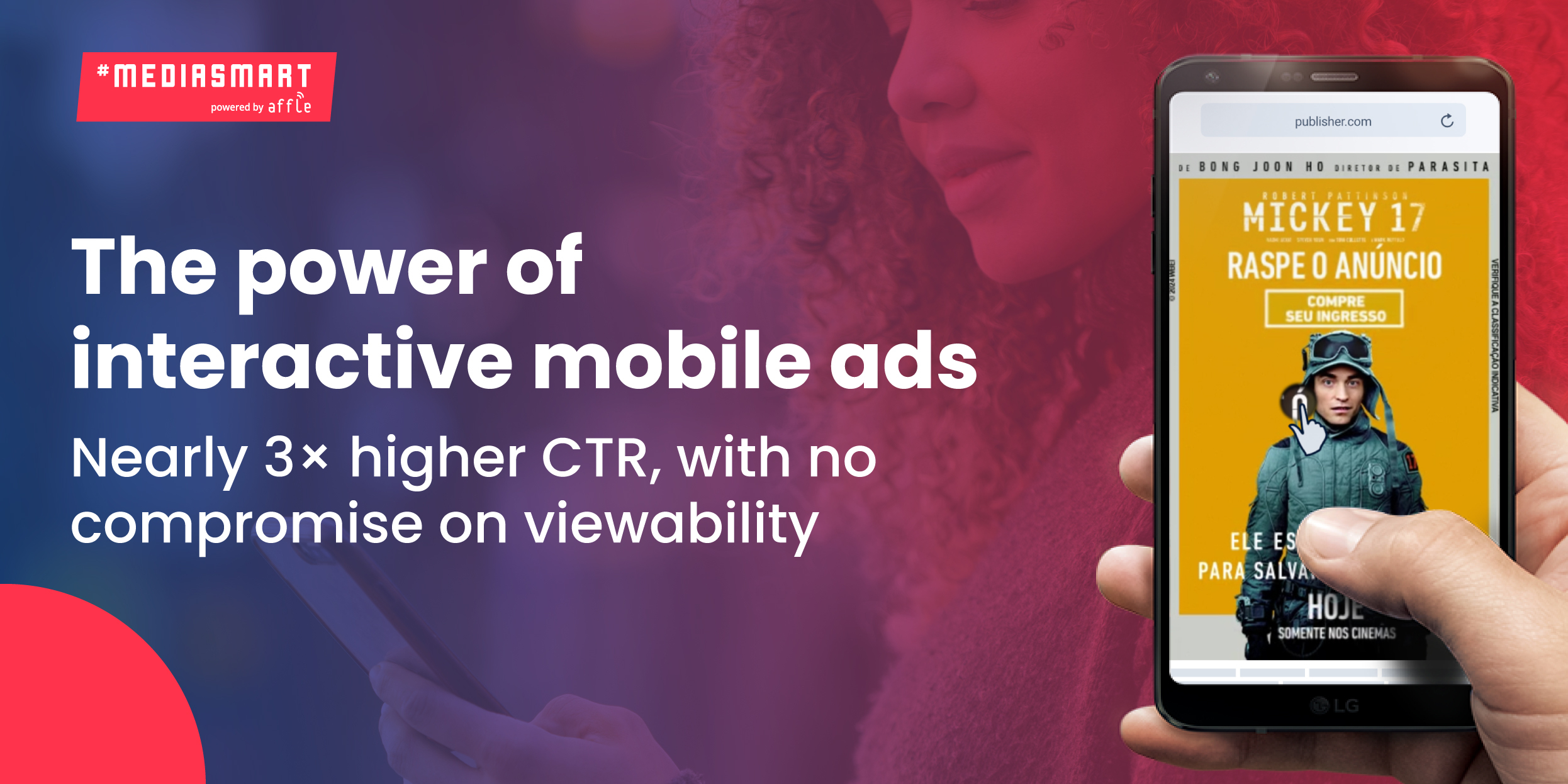
While the standard creative featured a static movie poster with a traditional click-through CTA, the interactive versions used three layouts from our partner Nexd, available through mediasmart's in-house Creative Studio. Each layout transformed the movie's main character into an interactive layer that users removed to reveal the trailer beneath, creating an engaging and intuitive experience.
- Scratch: Users scratched away the poster to reveal the trailer.
- Flip: Users flipped the poster to uncover the trailer.
- Slide: Users slid the creative aside to reveal the trailer.
Results:
Because every other campaign variable remained constant, the creative itself became the only meaningful differentiator. The interactive formats delivered nearly three times the click-through rate of the standard display creative, while maintaining virtually identical viewability.
| Format |
Average CTR |
Average Viewability |
| Interactive rich media |
3.65% |
72.53% |
| Standard display |
1.27% |
71.47% |
The findings show that creative optimization can deliver substantial performance gains without changing the media plan.
Why did interactive creative outperform?
The results weren't driven by animation alone. They came from combining interaction with a meaningful creative payoff.
- Interaction creates intent. Rather than passively viewing a banner, users actively engage with the ad, becoming participants instead of spectators.
- Every action had a reward. Scratching, flipping, or sliding immediately revealed the movie trailer. The interaction wasn't a gimmick—it naturally extended the story.
- The creative matched the content. Revealing the trailer by uncovering the movie poster felt intuitive and relevant. The interaction reinforced the campaign message instead of distracting from it.
- Attention turned into engagement. By inviting users to explore rather than simply click, the interactive formats created a more memorable advertising experience that translated into stronger campaign performance.
The takeaway:
This campaign suggests that creative optimization deserves as much attention as media optimization.
Interactive formats delivered nearly three times the CTR of standard display while running on the same inventory, targeting the same audience, and paying the same CPM. Instead of relying on premium inventory or larger budgets, advertisers can unlock meaningful performance gains by designing experiences that encourage purposeful interaction.
For marketers, the takeaway is straightforward: interactivity works best when it serves the creative idea rather than acting as a novelty. When the interaction feels natural and reinforces the message, it can transform standard display into a far more engaging experience.
Want to learn more? Read our partner Nexd's Complete article about the Case study
-Aug-04-2026-10-23-01-6514-AM.png)